
Two coats have been applied, the surface looks uniform and the contractor is ready for inspection. Has the specified membrane thickness been achieved?
In this hypothetical site situation, the inspection record confirms the number of applications. It does not establish how much material remains across the waterproofed area. A roller can spread the same quantity over very different areas, leaving a coating that looks continuous but is thinner than intended.
Thickness control therefore starts before the first pail is opened. The specification, material calculation and inspection method need to describe the same membrane build-up.
Start with the units
“Coverage” and “consumption” are sometimes used interchangeably in product literature. Read the units rather than relying on the heading.
|
Term |
Typical units |
What it tells you |
|
Coverage |
m²/kg or m²/litre |
Area covered by a unit quantity at a stated thickness |
|
Consumption |
kg/m² or litres/m² |
Material quantity required for a unit area |
|
Wet-film thickness (WFT) |
mm or µm |
Thickness while the applied coating is still wet |
|
Dry-film thickness (DFT) |
mm or µm |
Thickness after the specified drying or curing condition |
For the same material and application basis, coverage and consumption are reciprocals: 2 m²/kg equals 0.5 kg/m². Kilograms and litres are not interchangeable; converting between them requires the appropriate product density.
Also establish whether a figure applies to one coat or the complete membrane. Primer, reinforcement coats and protective topcoats should be identified separately.
Why counting coats is insufficient
Coat count describes the application sequence, not the finished thickness. A rough substrate presents peaks and depressions; pores and surface irregularities can take up material without producing the same build above the surface. Brush, roller, trowel and spray application also distribute material differently.
Product viscosity, levelling and curing behaviour influence the result. Excessive spreading can leave thin areas, while exceeding the permitted thickness per coat can affect curing or cause defects, including cracking in susceptible coatings. More material in one pass is not automatically better protection.
Resolve the application schedule before work starts. Confirm consumption, minimum total DFT, permitted build per coat, coat count, relevant density, volume solids where available, recoating conditions and curing requirements. If a required value is missing, obtain written clarification rather than deriving an application limit from a marketing description.
In Malaysia, record the actual substrate and weather conditions. A published waiting period should be read with its stated temperature, humidity and other qualifications.
Check the wet film while adjustments are possible
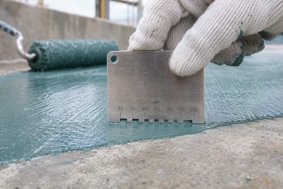
Where the product and surface permit, a wet-film comb provides immediate feedback. Select a clean, undamaged gauge with a suitable measurement range. Immediately after application, before skinning affects the reading, place it perpendicular to the surface so its reference teeth contact the substrate or the previous hardened coat. Remove it and identify the last wetted tooth and adjacent dry tooth: the film thickness lies between those graduations.
Agree representative inspection locations across each work zone, including open areas, upstands and accessible locations near details. Check again when the applicator, equipment or substrate condition changes. One satisfactory reading cannot describe an entire roof.
On rough substrates, the gauge may rest on surface peaks, giving a local reading above those peaks rather than an average across the profile. Textured products and reinforcement can further complicate contact and interpretation. Establish an appropriate alternative with the manufacturer where comb readings are unreliable. Make good disturbed test locations using the product’s approved procedure, and clean the gauge between checks.
Understand the wet-to-dry relationship
For a coating where the manufacturer confirms that a volume-solids calculation applies:
Estimated DFT = WFT × volume-solids fraction
A hypothetical coating with 80% volume solids applied at 1.25 mm WFT would yield an estimated 1.00 mm DFT:
1.25 mm × 0.80 = 1.00 mm
This illustrates the calculation; it is not a Cemseal application recommendation. Remember that 1 mm equals 1,000 µm. [4]
Solids by weight cannot replace solids by volume. Nor should an unspecified “solid content” percentage be assumed to mean volume solids. Cementitious and reactive systems require the manufacturer’s stated yield or conversion method; do not assume their curing behaviour follows a simple evaporation model.
Worked example using published Cemseal data sheet
The publicly accessible CEMSEAL PU-SC Technical Data Sheet, Issue W1, January 2026, states a membrane application rate of 0.65–0.70 kg/m² per coat, with at least two coats. It lists theoretical consumption of 1.3–1.4 kg/m² at 1.0 mm DFT.
For an illustrative 100 m² measured application area, using 0.70 kg/m² per coat:
- One coat: 100 m² × 0.70 kg/m² = 70 kg
- Two coats: 70 kg × 2 = 140 kg
- Illustrative 10% site allowance: 140 kg × 10% = 14 kg
- Membrane quantity for planning: 140 kg + 14 kg = 154 kg
The allowance is a budgeting assumption, not a manufacturer-prescribed rate. Adjust it for substrate conditions, detailing and handling losses. Include upstands and other coated surfaces in the measured area.
Primer remains separate. The same sheet states 0.2–0.3 kg/m², giving 20–30 kg for 100 m², before any separately assessed allowance or additional primer application.
Buying or using 154 kg does not prove uniform thickness. Material can remain in containers, be lost during application or accumulate in depressions. Confirm the project’s required DFT and application schedule before adopting this example.
Verify the cured membrane and retain useful records
Select the dry-film verification method for the actual membrane and substrate. Conventional magnetic or eddy-current coating meters require suitable metallic substrates; they are not universal instruments for waterproofing over concrete.
Ultrasonic measurement can suit some coatings on concrete, but suitability depends on thickness range, surface condition and acoustic behaviour. Its ability to distinguish layers also varies. Where appropriate, agreed destructive sampling can provide local thickness evidence, followed by an approved repair. Neither approach should be improvised at handover.
Record locations, coat numbers, readings, batches, quantities used, application times, conditions and corrective work. Reconcile usage against measured areas, keeping primer separate. This helps identify unusual consumption but cannot prove that every location meets the requirement.
Thickness verification and watertightness testing answer different questions. A satisfactory leak test does not demonstrate the specified thickness; thickness readings do not establish continuity at every joint or penetration.
A short site checklist
- Before application: Confirm the current product documents, total DFT, per-coat limits, units, measured areas, details and inspection method.
- During application: Monitor representative WFT readings where suitable, consumption and conditions. Avoid excessive spreading, premature recoating and unauthorised dilution. Inspect details as work proceeds.
- Before acceptance: Confirm curing, review records, complete the agreed thickness and watertightness checks, repair defects and approve protection before covering.
Cemseal’s technical team can help review the product data and verification approach for your project.
Wet-film gauge check during application
Technical detail: A clean comb held perpendicular to a suitable freshly coated surface, followed by a close-up showing the wetted and dry teeth. Include appropriate PPE.
Caption: Checking the wet film during application provides an opportunity to correct the coating before it cures.
Legal disclaimer
This article is provided by Cemseal Industries Sdn. Bhd. for general technical information. It does not constitute project-specific design advice, a product specification or a warranty. Recommendations are given in good faith based on the information available at the time of publication. Actual suitability and performance depend on the materials, substrate condition, design, exposure, workmanship and other site conditions.
The project designer, specifier and applicator must assess suitability for the intended application and refer to the latest applicable Cemseal Technical Data Sheets, Safety Data Sheets and written project recommendations. This article does not replace structural assessment, project requirements or applicable laws and standards. This article creates no warranty of fitness for a particular purpose. Any product warranty or contractual obligation is governed by the applicable written agreement and terms of sale. Third-party proprietary rights must be respected.
Copyright
© 2026 Cemseal Industries Sdn. Bhd. All rights reserved. Except as permitted by applicable law, no part of this article may be reproduced, distributed or republished without prior written permission from Cemseal Industries Sdn. Bhd. Third-party materials, trademarks and referenced publications remain the property of their respective owners.